1. Explain the preference in practical terms
State whether you want no added fragrance where feasible, particular products avoided, no air fresheners, or a specific household-supplied product considered. CCOHS notes that scent-free and unscented wording is not always consistent between products. A label alone therefore should not replace a conversation about the actual formulation and task. If a household member has a medically significant requirement, seek their appropriate professional advice and clarify whether the provider can meet the requested arrangement. A cleaning enquiry should not promise to prevent symptoms or make a home allergen-free.
2. Agree on products before the day
Ask which products are proposed for floors, counters, bathrooms, and any requested detail work. Share relevant manufacturer care instructions and any known restrictions. Health Canada recommends label-led use and ventilation; its indoor-air guidance also discusses low-emission product choices. A low-fragrance preference does not make an unsuitable product compatible with a particular finish. If you supply materials, confirm their original labels, suitability, and whether the provider accepts them. Avoid improvising a mixture or substituting a familiar product after the agreed plan has been established.
3. Make a clear pet arrangement
Describe the animals present and the rooms or doors involved. Agree who will secure them, where they will stay, and how access will be managed during the visit. Tell the provider if a pet may react to a vacuum, an open door, or unfamiliar visitors. Do not assume the cleaner is providing animal supervision, walking, or handling. Keep food, bowls, toys, leads, and bedding arranged as agreed. The plan should prevent confusion about which door can open and who is responsible for the animal throughout the working period.
4. Define hair, textiles, and odour tasks
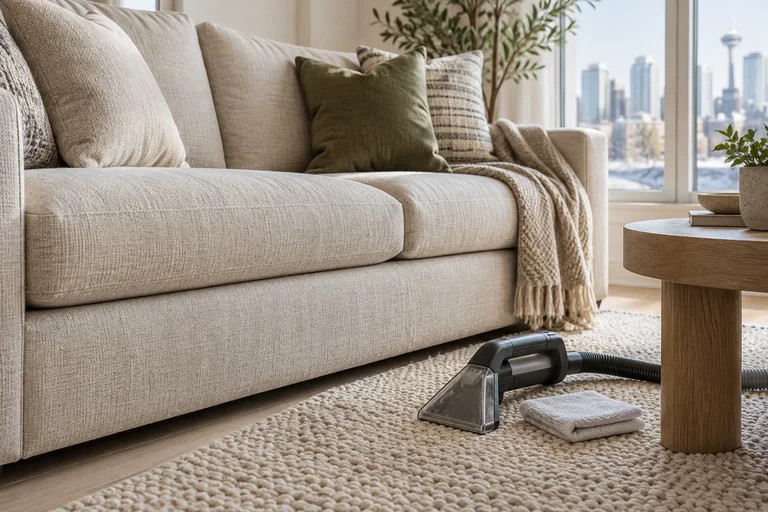
Pet hair on accessible hard floors, a sofa, curtains, or a rug can involve different tools and time. State the surfaces and whether upholstery or carpet extraction is requested as a separate service. Ordinary vacuuming is not equivalent to deep textile treatment. Tell the provider about known accidents or staining before the visit; affected material and the nature of the issue determine whether ordinary cleaning is appropriate. Established odours, damage, or contamination may require a different assessment. Do not treat a stronger fragrance as evidence that the underlying task has been completed.
5. Use a realistic household example
Imagine a condo with a cat, a wool-look rug of uncertain fibre, and a request to avoid perfumed bathroom products. The brief could prioritize accessible floors and bathroom surfaces, identify the rug label before any wet treatment, agree on products, and keep the cat in a separate room managed by the owner. The litter area can be discussed explicitly, including what the provider will handle. That is more useful than requesting a pet-safe package with no explanation of materials or animal arrangements. The provider can then confirm capability and an appropriate scope.
6. Keep the preference record useful
After the visit, review the agreed tasks and any product or access concerns. Keep a short list of approved preferences for later visits, while recognizing that formulations and surface needs can change. Ask about any remaining damp areas or product-specific re-entry directions from the provider. Cleaninghouses.ca can receive the household preferences, pet arrangements, and priority rooms to begin a scope discussion. Availability and suitability are confirmed for the address; a general preference request is not a certification that every possible household sensitivity or animal circumstance has been addressed.
Your practical checklist
- Describe the fragrance preference precisely.
- List products or ingredients you want discussed.
- Share relevant surface-care instructions.
- Confirm the provider accepts any supplied products.
- Arrange pet supervision and a separate space.
- State which hair and textile tasks are requested.
- Disclose known accidents or unusual contamination.
- Review product instructions and future preferences.
A few helpful answers.
Does unscented mean every household will tolerate a product?
No. Product wording and individual circumstances differ. Discuss the actual product and task, and seek appropriate professional advice for medical needs. A cleaning service should not guarantee a health outcome.
Will pet-hair cleaning include every soft furnishing?
Only the surfaces and methods agreed in the scope. Accessible vacuuming, upholstery treatment, rug care, and carpet extraction are different tasks. Identify the material and request any specialist textile work explicitly.
Care references
General planning guidance, reviewed October 15, 2026. Follow the instructions for your particular finish and product.